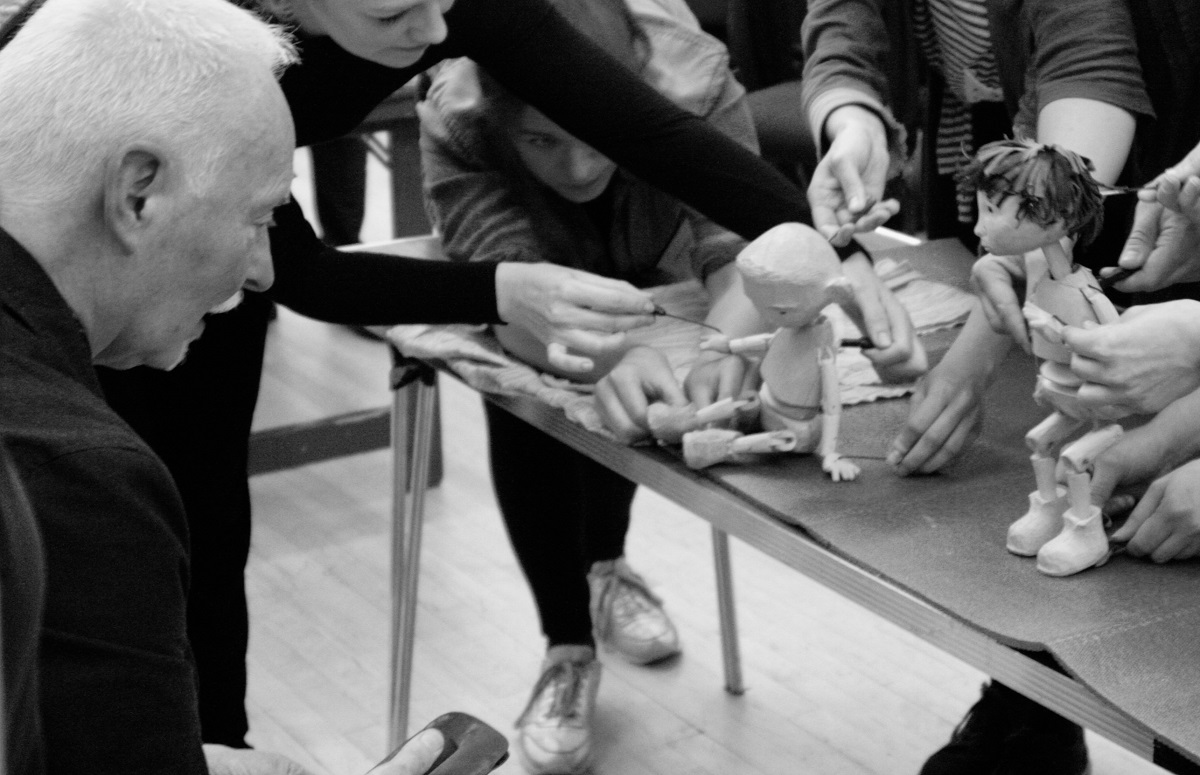
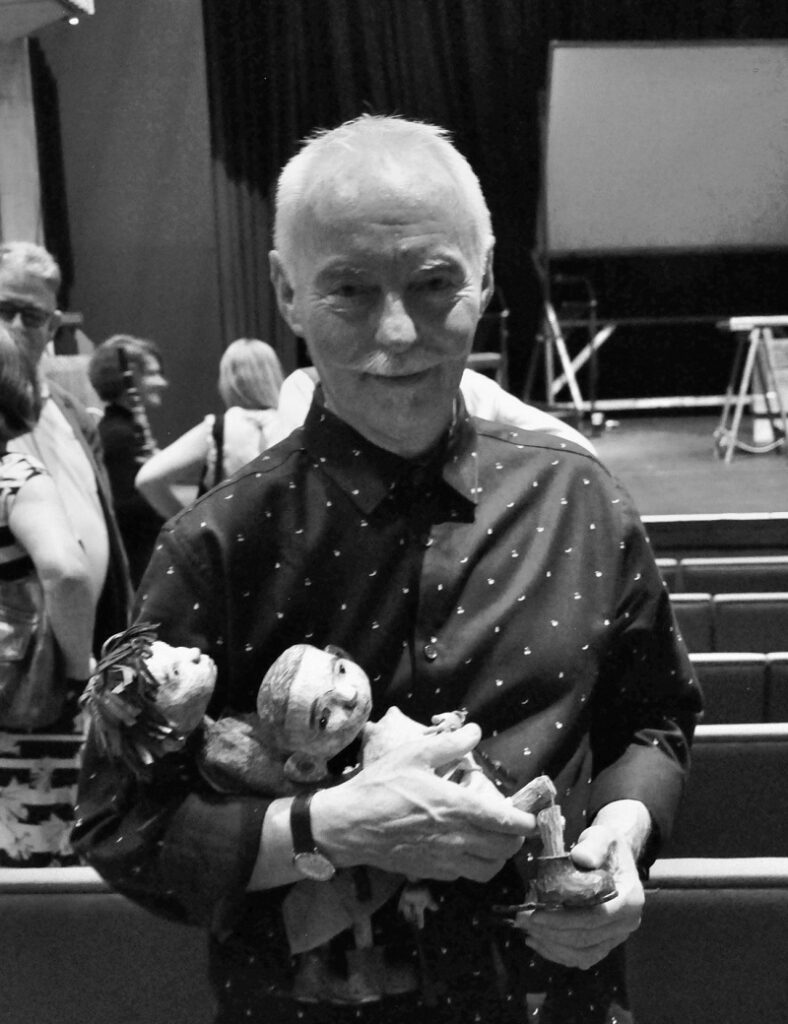
With his exhibition Gwrach | Witch: A Fairy Tale Retold currently showing in Carmarthen’s Oriel Myrddin, Clive Hicks-Jenkins sits at his kitchen table – somewhere in Monmouthshire, between a country lane and a cluster of walkable pubs – and chats to Antonia LeVay.
Where he lives, who he meets, the warmth or chill of a community – all things which seep directly into Clive Hicks-Jenkins’ art. Once, when living in rural Ceredigion, the nearest pub was an unwelcoming fluorescent-lit outpost, and he visited it twice in 20 years. Here, he’s back on what he calls “my patch”, and there’s a livelier mix: farmers and writers, creatives and professionals, old estates and working land.
Hicks-Jenkins, now in his mid-seventies, understands that nothing in his world exists in isolation. Art, storytelling, food, film, words, puppets, politics, childhood fear and adult dread all sit together, elbow to elbow. “I never thought I’d become a pub person!” he tells me. “But it isn’t about drinking – it’s about conversation, storytelling; that sense of shared history. People talk, argue, they tell stories – that’s vital to what I do.”
If the Newport-born Hicks-Jenkins sounds like a man operating slightly sideways to his own field, that’s because he is. Though celebrated as a painter, illustrator, and theatre designer, he never went to art school: “I just had to find my way,” he says.
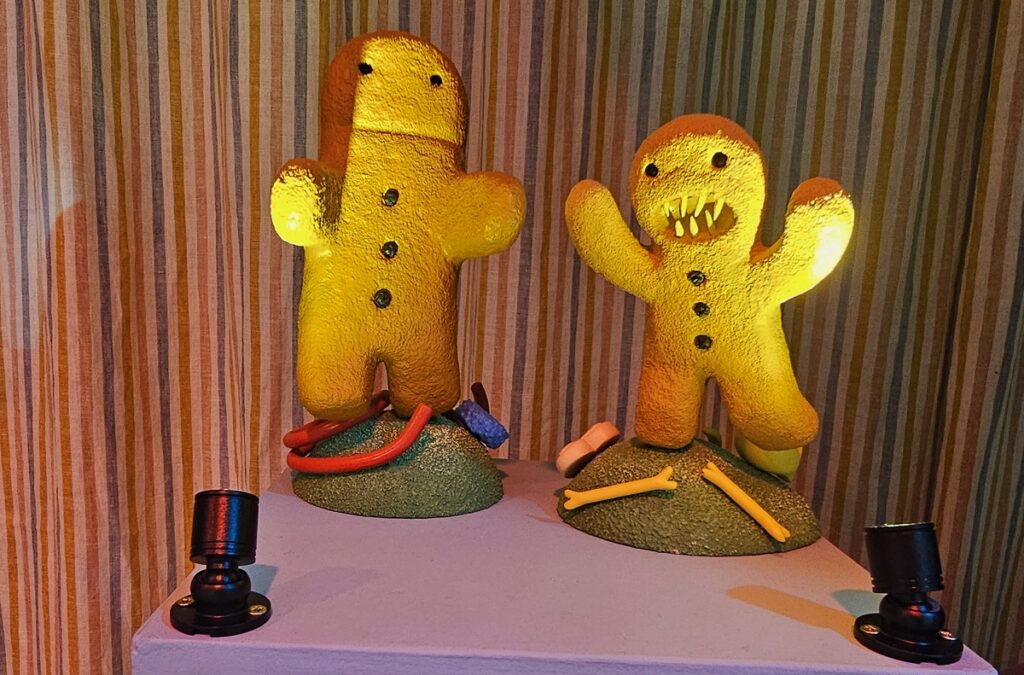
It shows. His work resists easy categorisation, darkly playful, richly coloured, macabre, unsettling without being cruel. Viewers often spot echoes of modernists from Picasso to Matisse or Georges Braque; others detect something older and stranger in the awkward medieval proportions and gothic unease, perhaps a visual equivalent of Edgar Allan Poe or the Marquis De Sade. References with which Hicks seems genuinely pleased.
“My absolute favourite painter is George Stubbs,” he says, “but there’s a huge gap for me from the Renaissance back to early Gothic – before painters became obsessed with perfect realism. I like when artists had to rely on imagination rather than lenses or devices. That awkwardness makes them modern.”
As such, Hicks-Jenkins is a staunch advocate of outsider art – particularly work made by people isolated from society, often institutionalised, creating entire worlds with no reference points but their own minds. “There’s a purity there – and darkness and imagination, like children’s art before it gets educated out of them.”
A purely visual artist in terms of his own work, Hicks-Jenkins is however keen to emphasise his literary roots (“I’ve always loved writers – if you came into my studio, you’d find poetry pinned everywhere. No postcards of paintings!”) and talks with reverence about how 20th-century English painter Winifred Nicholson kept notebooks describing colours in poetic terms like “the grey-blue of a vein in a baby’s temple”.
“That changed everything for me,” he says. “Words could take me straight back to a colour I’d seen days before. A sketchbook never could.” When he takes walks, then, he writes notes on mood, colour and feeling, before returning to the easel – and when the painting arrives, it does so through recollection more than representation. This is an untaught skill, like most of Hicks-Jenkins’ practice.
Many technological developments worry him, he admits to me, with visual art forefront in that concern. He recalls walking through major exhibitions filled with monumental, hyperreal portraits clearly copied from photographs. “It breaks my heart that this is considered art,” he says. “The camera’s eye sees differently. But people don’t notice anymore because they’re always looking through one.”
Film, too, has suffered. Hicks-Jenkins is a lifelong cinema obsessive – raised on melodramas with his mother, sneaking into British noirs, watching Hitchcock in fleapits of yore. The pre-digital inventiveness has plenty to do with that appreciation: stop-motion, matte paintings, in-camera magic. The late Ray Harryhausen, a pioneer of special effects, was a friend of Clive’s (and, like him, an occasional puppeteer).
“CGI serves itself,” he says bluntly. “Designers think they’re using it, but they’re {serving} it. Everything looks the same.” Even so, he’s conscious of a heightened appreciation – if not a full return – among film buffs of puppetry, hand-made effects and general physical presence. “When something happens in real space, it’s visceral. The actor is inside it. That matters.”
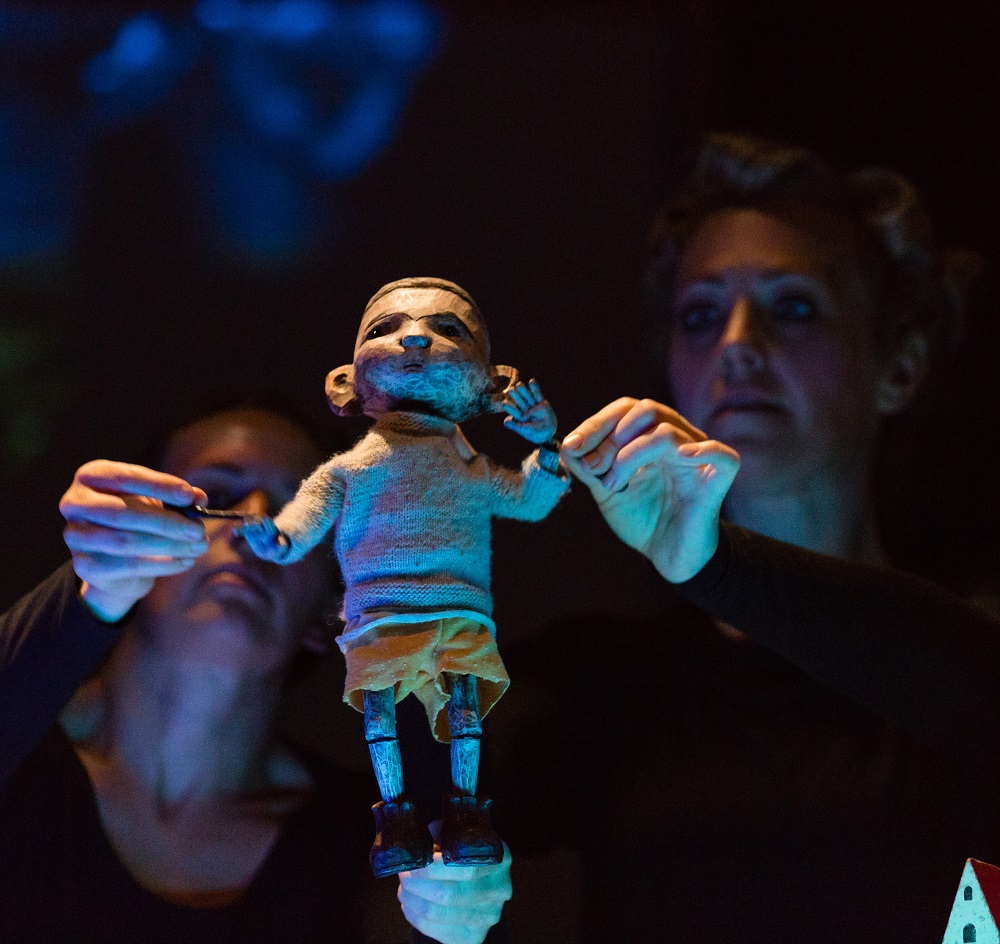
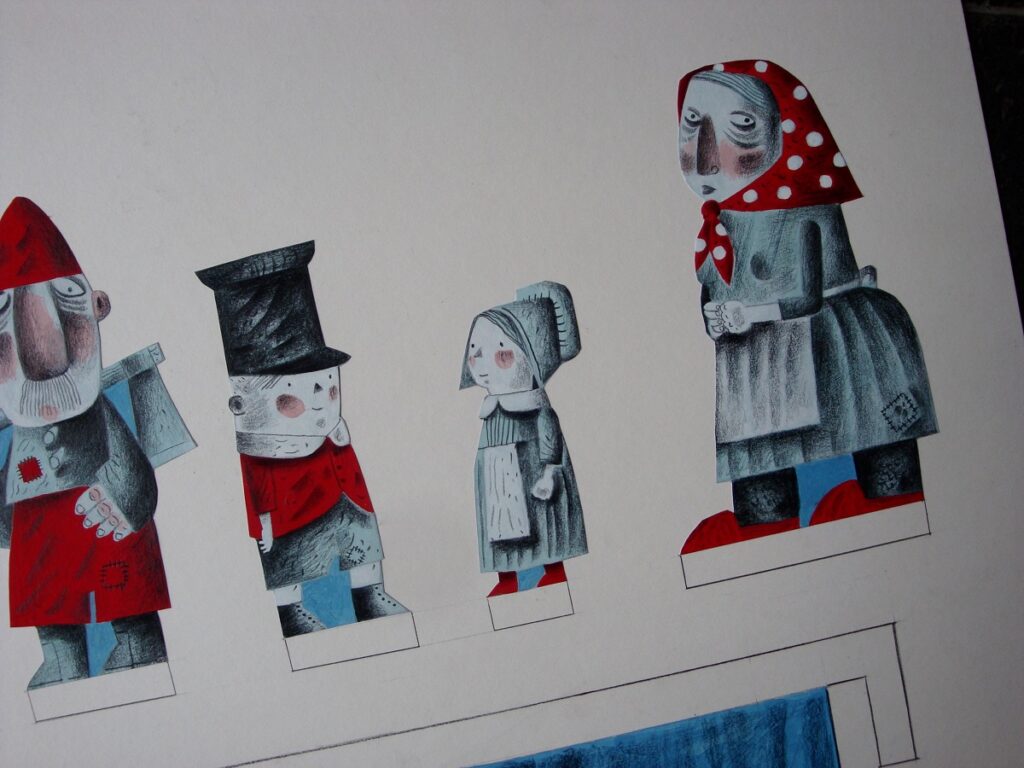
Which brings us to Gwrach | Witch: A Fairy Tale Retold. This is Clive Hicks-Jenkins’ immersive exhibition at Oriel Myrddin, a Carmarthen art gallery which reopened late last year after a lengthy period of refurbishment. Gwrach | Witch encompasses 2D art, puppetry, sculpture, design work and installation, and its overarching theme is the artist’s longstanding engagement with Hansel & Gretel, as in the Brothers Grimm’s famous tale.
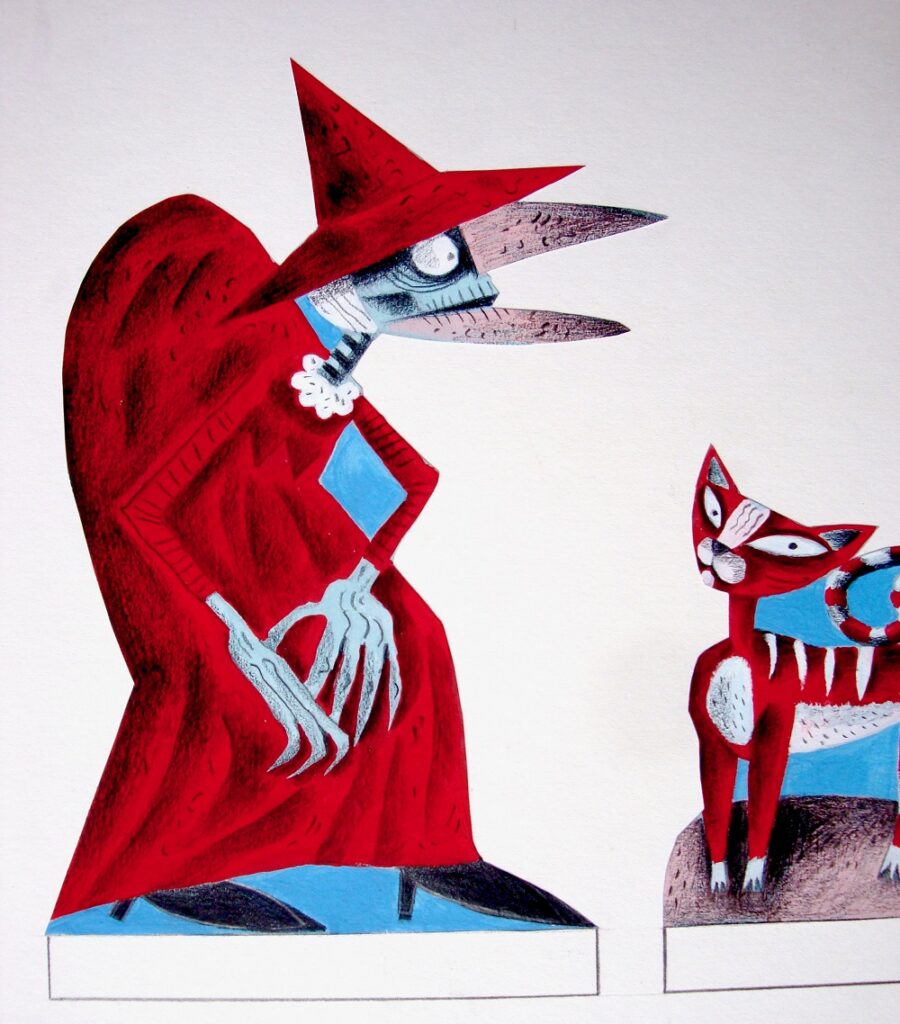
That engagement (which is only Hicks-Jenkins’ latest of many such artistic fixations on classic folk stories down the decades) began around 15 years ago, when he produced a set of darkly illustrated enamel plates made with children’s craft pens, as a private joke of sorts. (“I never intended for anyone to see them! They stayed in the house. We used them…”) Since when it’s grown into an astonishing, multi-form creative universe.
The joke caught on: in 2014 the St Jude’s print gallery commissioned Hicks-Jenkins to pen his illustrated spin on H&G for their magazine, Random Spectacular, then two years later published an embellished version as a book. Here, we encounter Gretel as a budding serial killer, with the fairytale curdling into Grand Guignol absurdity – dark, funny and knowingly adult.
Benjamin Pollock’s Toyshop, a Covent Garden store of Victorian vintage, approached Hicks-Jenkins with a view to collaborating – and baulked at what he delivered. “They said, ‘Absolutely not. This is horrifying!’” he laughs. “So I made another version…”
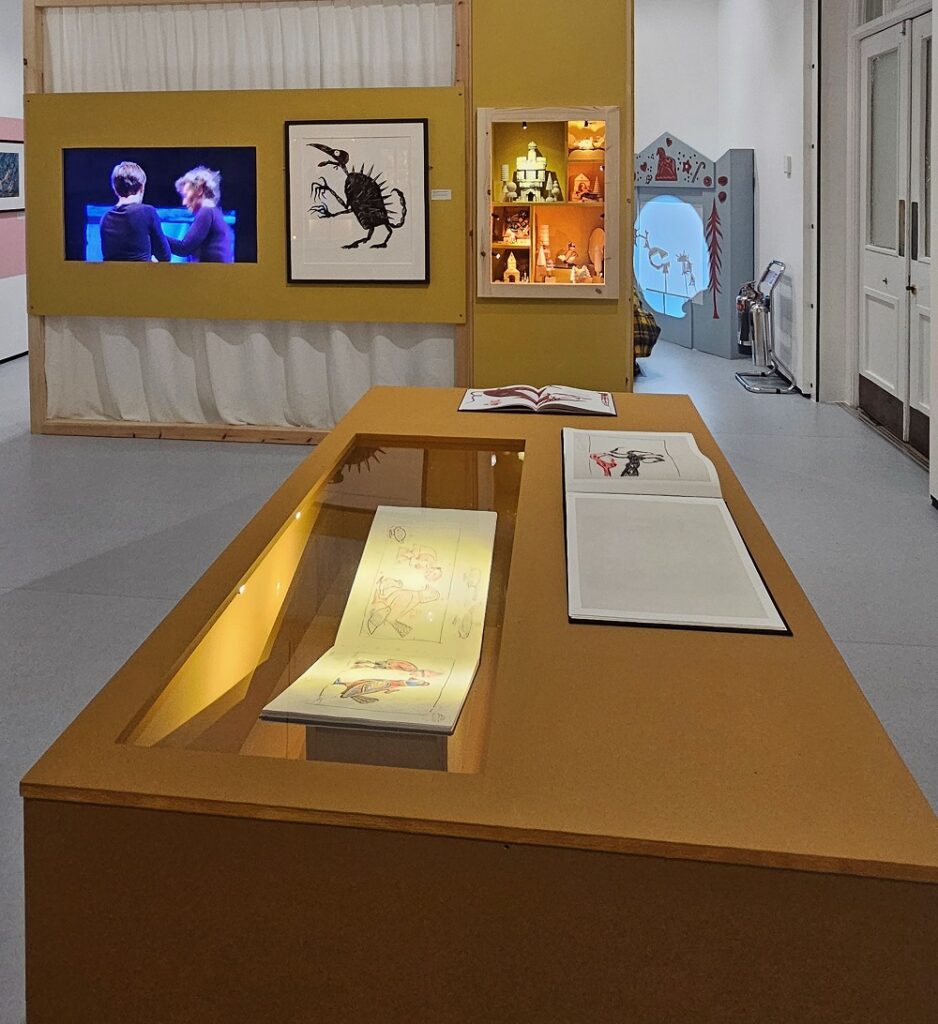
Soon, the story was splintering, each retelling opening a different door in the forest. A producer suggested Hicks-Jenkins’ Hansel & Gretel as the basis for a music theatre project; the artist proposed Simon Armitage, who he was already working with, as its librettist. The Yorkshire poet’s response? “I don’t want to do anything like that book. It’s the most horrifying thing I’ve ever read!”
So ultimately, Armitage reimagined his colleague’s reimagining, moving the tale to a warzone. Instead of Hansel and Gretel’s parents being feckless, they’re loving; abandonment becomes misunderstanding, and the children’s witch foe is a trafficker. Armitage’s Gretel mishears everything, her trauma causing her to interpret reality as horror. The outcomes remain brutal, but their meanings shift. “That felt true to childhood – you overhear half-conversations and misunderstand. The adult world is unknowable,” Hicks-Jenkins says.
Calling Armitage’s libretto “the best I’ve ever read” to me today, the stage production was designed and directed by Hicks-Jenkins, toured successfully in 2018 and was adapted by the duo into a second illustrated book. And still the story refused to stop growing.
Gwrach | Witch began as an idea to show illustrations, but expanded into something far more extensive: as Hicks-Jenkins puts it, “It spread sideways, like throwing a stone into water. The rings just kept going.” Musicians, designers, publishers and animators all play their part in the exhibits. “That’s what art should be – a little thing, not a grand, overfunded idea. No money. And then it grows, like a tadpole. Legs appear and suddenly you’ve got frogs everywhere.”
Hansel & Gretel, he says, remains endlessly open – an archetypal story that can be retold infinitely. “I could do 16 books on it, all different.” After all, for Clive Hicks-Jenkins, art is less about arriving than wandering, mishearing and turning down darker paths just to see where they lead. Or, as he puts it – figuratively returning us to the pub – “Everything I care about starts with people telling stories. The rest follows.”
Clive Hicks-Jenkins: Gwrach | Witch: A Fairy Tale Retold, Oriel Myrddin, Carmarthen, until Sat 14 Mar.
Admission: FREE. Info: here
words ANTONIA LEVAY